OPERATIONS AND INTERLOCKING SIMULATION
FOR TRAINING & PLANNING
BEST – the solution to growing challenges in training
Modern interlocking systems and control centres rely on state-of-the-art technology to ensure smooth, safe operations and the qualified training of operating personnel is a basic requirement.
Scheidt & Bachmann System Technik, together with its partner Trans-SYS Kft, have developed the BEST operations and interlocking simulation system in order to meet the increasingly stringent training requirements on a long-term basis. With its realistic simulations, BEST is also used for planning line sections and interlockings as well as the specification of new systems.
For some 30 years, BEST has been deployed with great success by a great many European railway and metro operators. Every year, more than 10,000 train controllers take part in training courses on the simulator. BEST accurately reproduces the user interface of the original systems, including all the necessary operating menus. The simulation of the interlocking technology with all its external installations and train movements provides users with a highly realistic impression.
The system simulates a range of different interlocking technologies (mechanical, relay, electronic) made by a variety of manufacturers. In addition, existing simulations can be extended to include new technologies and individually adapted as needed. For example, BEST can be used to simulate both the existing interlocking technology and the new, control and operating systems.
The BEST training system:
- Training periods are shorter and can be more flexibly planned
- Improves staff confidence in daily handling
- Hazard-free malfunction and stress training
- Trains realistic scenarios (including timetables and disruptions)
- System is independent of manufacturer and type of interlocking
- Can be deployed as a multi-user system, a web-based single-user system, and as a learning platform for unassisted training
- Training for new installations is separate from commissioning
- PC components are independent of the original system
Beginning training earlier
The training system for interlockings is based on the same platform as the planning system. This means that data prepared during the planning process can also be used for training purposes. Therefore, no additional work or expenditure are needed to create training software. With the BEST simulator, training for a new interlocking can begin in good time, prior to commissioning.
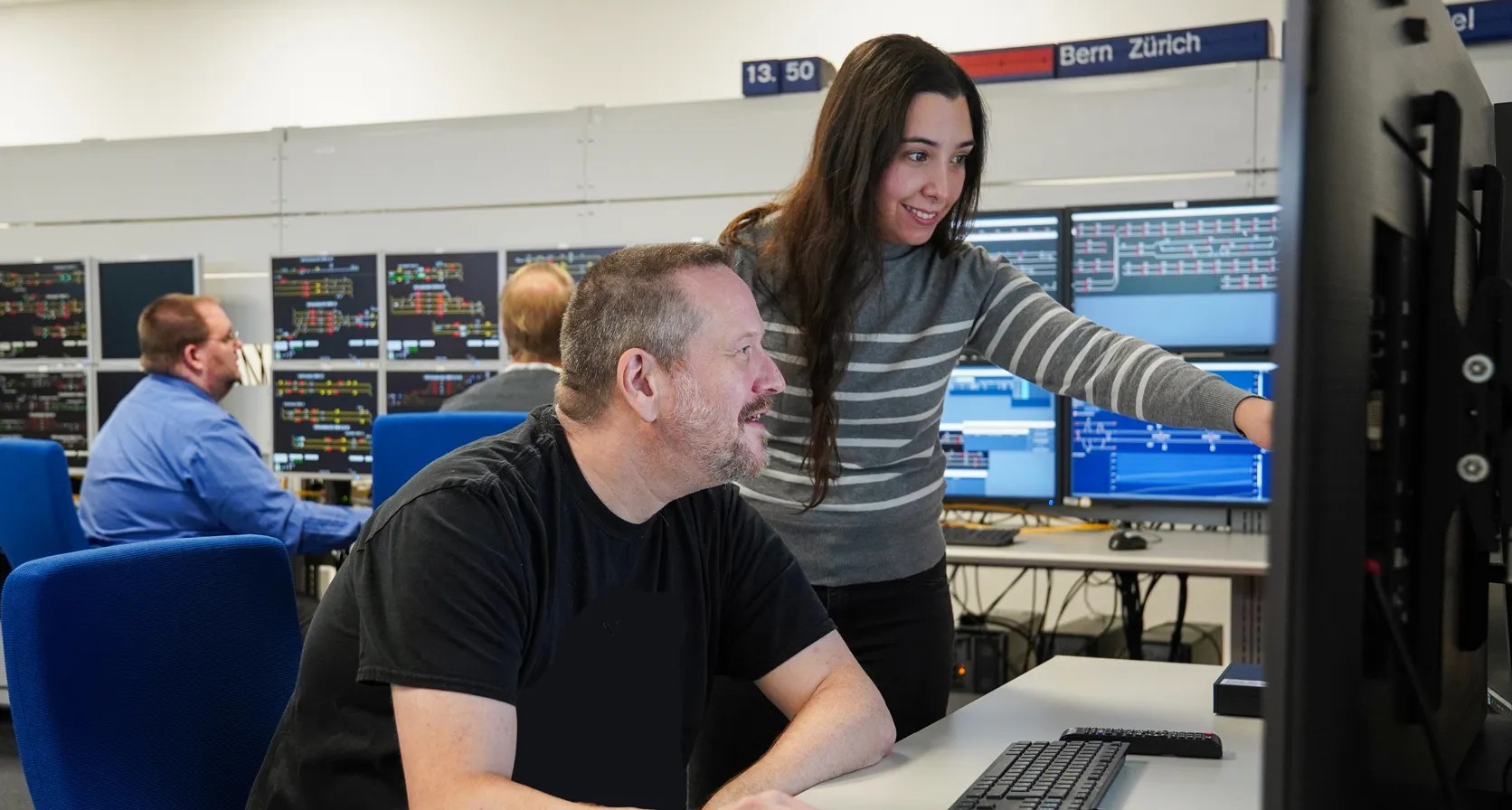
For basic and further training
BEST is used in all aspects of training, whether basic training for new staff or further training courses for qualified employees. Even experienced train controllers need training when it comes to commissioning new interlockings or when there are changes in operation programmes. Furthermore, train controllers are required to take part in periodic refresher courses and tests in order to retain their authorisation for operating interlocking systems. Any influence on actual rail operations as a result of training measures is ruled out from the start. Compared with other training methods, simulation with BEST shortens the training period by up to 30%.
As the vast majority of operations in interlockings and control centres are trouble-free and a matter of routine, many controllers are no longer familiar with the special operating procedures required if system components fail or malfunction. Up to 400 different failures can be simulated to help operators learn the correct course of action in malfunction situations so that smooth operation is ensured.
Components and configurations
BEST – components and configurations
The simulation software meets the requirements for every level of training and can be implemented in a variety of configurations. Multi-user simulation systems reproduce every detail of modern control centre workplaces, making it possible to train realistic scenarios. The training units are all controlled and monitored by qualified supervisors.
Single-user simulators are also being increasingly deployed as a training method so that trainees can engage in further training through self-learning or prepare for important training programmes. Trainees operate these simulators themselves and work on specifically prepared practice scenarios.
BEST can also be integrated in the training as a learning platform and training content can be prepared for the learners on this basis. Practical tasks for various types of interlocking can be created for immediate application of the content taught and stored together with sample solutions.
The learning platform can be accessed from any location using a PC or a tablet, giving learners the opportunity to work on tasks individually and expand their knowledge independently. Separate software solutions for different applications are not necessary, as BEST fulfils the entire range of requirements – from stationary simulation systems to web-based training.
Simulation of interlocking logic and external installations:
- Real topography
- Manufacturer-specific differences taken into account
- Simulation of time behaviour in real time
Simulation of train and shunting movements:
- Rail operations according to timetable
- Interfaces to external timetable systems
- Manual setting of any train and shunting movements
Simulation of technical and operational failures:
- Adjustment of failures at all key external installations
- Realistic impact on operations
- Delays, re-routing, train disruptions
Multi-user simulation:
- Interaction of multiple interlockings, even of varying technologies
- Training of dispatching and safety-relevant actions extending beyond interlocking
Analysis of the simulation:
- Analysis of delay minutes in timetable operations
- Documentation of operating actions and non-compliance with regulations
BEST Planning system
With BEST: optimised planning and cost-effective implementation
Simulated planning reduces work and expenditure
With BEST operations and interlocking simulation, the interlocking is simulated in detail right from the early planning phases. All the interlocking functions, engineering variants, monitor images and the entire timetable are displayed together with the realistic running behaviour of trains. The operating interface is identical to the impression that the operators will find in their daily work. This provides the basis for functional and operational verification in a manufacturer-independent test environment. As soon as planning is completed, the sequence of operations is simulated and assessed – independent of the original interlocking.
Tested, uniform data improves quality
In addition, BEST offers the advantages of an integrated, electronic data management system that enables interfaces to be integrated in existing database systems and planning tools. Following completion of the planning work, all the data are exported in a defined format. If necessary, the interlocking manufacturer can work with the electronic data and receive a draft of the monitor images produced during the planning process. At the end of the planning stage, verified and validated plans of tested and confirmed quality are available.
User-friendly implementation of new systems
The main challenge when developing new control and safety technology lies in adapting highly complex and automated processes to meet users’ requirements. The BEST simulation system has already been used in several new developments for specification and prototyping purposes. In the simulator, future users are confronted with the new system in a realistic operational environment, enabling user-oriented improvements to be integrated in the design process before the system is implemented.
Networking and information exchange
Scheidt & Bachmann System Technik organises conferences and workshops for users of the BEST operations and interlocking simulation system at regular intervals. These events provide users with an effective platform for exchanging information on the BEST application options.
The BEST planning system:
- Functional and operational testing of interlocking planning processes
- Reduces extra costs due to supplementary work required to operate new projects
- Human factor integrated in interlocking planning
- Specification and prototyping in a realistic operational environment
- Redundancy-free data storage and quality assurance in the planning process
- Import and export of data
- Electronic interlocking data available to the manufacturer
- Statistical analyses
References:
Deutsche Bahn AG
Österreichische Bundesbahnen
Schweizerische Bundesbahnen
SNCF Réseau (France)
BLS AG (Switzerland)
Rhätische Bahn (Switzerland)
Travikverket (Sweden)
Israel Railways
PKP PLK (Poland)
CFL (Luxembourg)
Infrabel (Belgium)
Hochbahn AG (Hamburg)
Stuttgarter Straßenbahnen
Stadtwerke München
Berliner Verkehrsbetriebe
Üstra Hannover
Wiener Linien
Verkehrsgesellschaft Frankfurt
SMRT (Singapore)
Verkehrsbetriebe Karlsruhe
Stadtwerke Augsburg
Stadtwerke Bonn

Your direct contact:
Bert Ritscher
Tel. +49 160 4424653
sales@scheidt-bachmann-st.de

Frank Dohmen
Human Resources

Yvonne Kuzmanovic
Human Resources
Scheidt & Bachmann GmbH
Breite Str. 132
41238 Mönchengladbach